


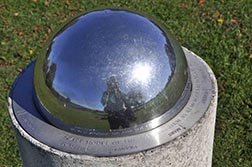
A quirky form of heritage included in the UNESCO–IAU Portal to the Heritage of Astronomy are the “Places Connected to the Sky”, places that are connected to the sky in out-of-the-ordinary ways. Prominent among these is the Otford Solar System, a scale model of the solar system centred in south-east England but extending out to four of the nearest stars, which can be found in museums around the planet.
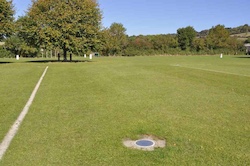
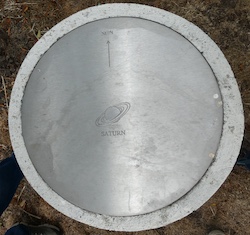
The sun (shown above) is football-sized (30.3 cm across). At this scale, Earth is the size of a small ball-bearing (0.3 cm across) some 32m away. Jupiter, the largest planet, is 162m away and still smaller than a ping-pong ball (3.1 cm across). Each of the eight planets is shown to scale on a metal plate placed on a concrete pillar (except Mars, which is flat in the ground) in and around the village. As the model was set up prior to 2006, Pluto is also there out in the fields, about 1km in a direct line from the sun.
Photo above: Mars in the ground with the inner solar system pillars in the distance. Photo below: Saturn.
The positions of the planets reflect their spatial configuration at the turn of the millennium, when the Otford Solar System was constructed, but to my mind the important thing is to visualise distances. The planets are reduced to tiny spheres in the space you walk around to get from one to another.
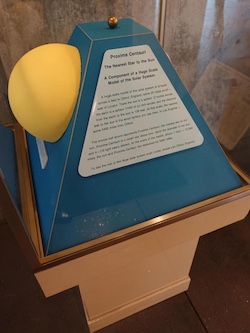
That said, what makes the Otford Solar System so special in my view is the inclusion of four of the seven nearest stars as an integral part of the model, made to scale and placed in museums around the world: Proxima Centauri (just 4 cm across) in Los Angeles, Barnard’s Star (6 cm across) in Port Stanley, Sirius (bigger than the sun, 52 cm across) in Sydney, and Ross 154 (7 cm across) in Christchurch, New Zealand. Their (great-circle) distances from the Otford sun are all correct to within about 5%.
Photo below: Proxima Centauri (the small brown sphere on top of the display stand) at home in the Griffith Observatory, Los Angeles.
The idea of humanity visiting other stars, if you ever held it, becomes absurd. On the Otford scale, one would have to go round the world one and a quarter times (about 26,000 km, the Earth’s circumference being about 20,000 km) in order just to reach Tau Ceti (the closest star similar to the sun, which some favour as the nearest candidate in the search for extraterrestrial intelligence).
As the extended Otford model makes clear, stars near to us are minuscule specks in comparison with the amount of space between them. There may be a hundred billion stars in the disc of our galaxy but at the Otford-model scale they would be scattered all the way out to the actual sun, plus a third of that distance in the other direction. (The distance out through the galactic centre scales to some 160 million km, a bit further than the actual sun at 150 million km.)
I recommend visiting the Otford Solar System if you get the chance. Walking around it helps you picture the extraordinary scale and emptiness of space and the extreme tininess and isolation of our home, planet Earth. If that is not an argument for ensuring our planet remains habitable for generations to come, it is hard to know what is.
Read more about the Otford Solar System on the Portal to the Heritage of Astronomy here.
Photo of Proxima by Edwin C. Krupp; other photos taken by Clive Ruggles in 2018 and 2026


 If you are looking for things related to Alice and/or information about stalking, please visit the